
Fox Harbour observatory uses the same camera technology found in Reach’s Digital Diver Camera System.
NANAIMO, BRITISH COLUMBIA — October 14, 2026 — A Reach Systems Auk underwater camera is helping researchers and the public watch marine habitat develop at an artificial reef in Newfoundland and Labrador’s Placentia Bay.
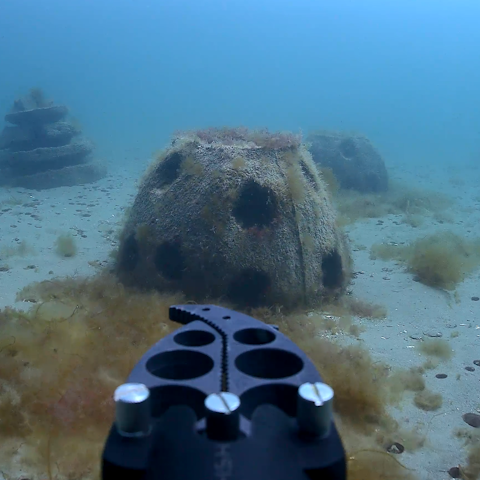
Led by the Fisheries and Marine Institute of Memorial University of Newfoundland, the Fox Harbour project uses concrete reef balls to restore and enhance marine habitat. Reach’s camera provides a recurring underwater view of the site, contributing to a visual record of how marine life responds over time.
“At the end of the day, healthy oceans benefit everyone,” said Mark Santos, fisheries technologist with the Marine Institute’s Centre for Sustainable Aquatic Resources. “This project is helping us better understand how marine habitats recover, how fish and other species use artificial reefs, and how we can use science to make better decisions that protect our oceans for the future.”
Cunners, crab, lobster, sea urchins, kelp and algae are among the species observed around the reef. The camera captures two-minute recordings every hour, with excerpts available to the public through SmartAtlantic.ca. Full recordings are stored locally for retrieval and research.
“We’ve been measuring the reef using sonar surveys, ROVs, divers, and long-term monitoring,” said Santos. “Every survey gives us a better picture of how the reef is developing, and the information we’re collecting will help improve future habitat restoration projects here in Newfoundland and Labrador.”
The observatory’s monitoring system is expected to remain in place for up to nine years, supporting a long-term understanding of the habitat’s development.
Learning from real-world deployment
The project also provides practical lessons for operating underwater technology at a remote site where access and hands-on intervention are limited. Following operational challenges, the Marine Institute team added a remotely controlled on-off switch to allow the Auk camera to be power cycled without visiting the site.
The deployment is helping identify what long-term marine monitoring demands of both the equipment and the surrounding system, from image quality to remote troubleshooting.
From reef monitoring to commercial diving
The Auk camera used at Fox Harbour is also the camera used in Reach’s Digital Diver Camera System (DDCS), connecting this research application to the visual documentation needs of commercial divers.
The DDCS combines full high-definition underwater imaging with adjustable lighting topside controls and recording software. Its next-generation software supports up to four simultaneous camera feeds, image controls for challenging visibility and recorded audio commentary, helping dive teams capture and communicate underwater findings.
Whether documenting marine life around an artificial reef or inspecting submerged infrastructure, clear footage gives people on the surface a better view of conditions below.
Explore the Fox Harbour reef ball observatory. Learn more about Reach’s Digital Diver Camera system at divecams.com.
About Reach Systems
Reach Systems is a Nanaimo, British Columbia-based company designing and manufacturing marine technology for subsea, offshore, and industrial applications. Reach’s product portfolio — including cable handling systems, winches, reels, underwater cameras, and video inspection systems — is used by defence, scientific, and commercial customers in some of the most demanding field environments on earth. The company’s work on controlled payload deployment for uncrewed platforms is helping define how the next generation of ocean missions will be carried out. For more information, visit reach-systems.com.
Media Contact:
Priscilla Johnson
VP, Marketing
Reach Systems
pjohnson@reach-systems.com